To keep our subscribers up to date with relevant timeshare industry news and guidance, we’re sharing the latest newsletter from the Timeshare Consumers Association (TCA) below.
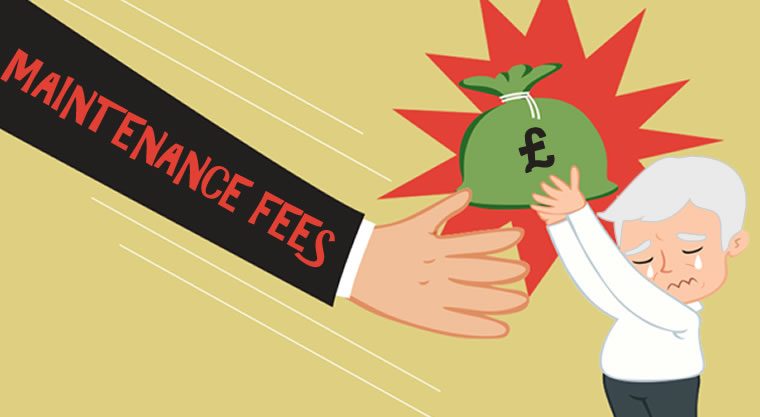
If you own a timeshare, you’ll already know you’re contractually liable for annual maintenance fees. What has always surprised us is how many resorts issue the yearly invoice just before Christmas. It’s rarely a welcome bill at the best of times — and it feels even worse landing in the middle of an already expensive festive season.
A few choice words often follow when you realise the maintenance fee has increased yet again. Realistically, it’s far more likely that maintenance charges will keep rising than drop. In many cases the annual uplift might not exceed a “standard” 5%, but even at that level the medium-to-long-term impact can make a serious dent in your household finances.
For example, if your 2020 maintenance bill was £900, you’re an RCI member, and the fee rises at a modest 5% per year: by year 5 the maintenance charge would be £1,249; by year 10, £1,594; and by year 20, a staggering £2,598. Another sobering point is that by year 20, the total amount paid in annual maintenance fees would equate to £33,990.15.
Once you add your original purchase cost, you’re looking at a very substantial outlay for something that offers no investment return — and aside from holiday memories, provides you with no financial return when your contractual term ends.

Shock horror!
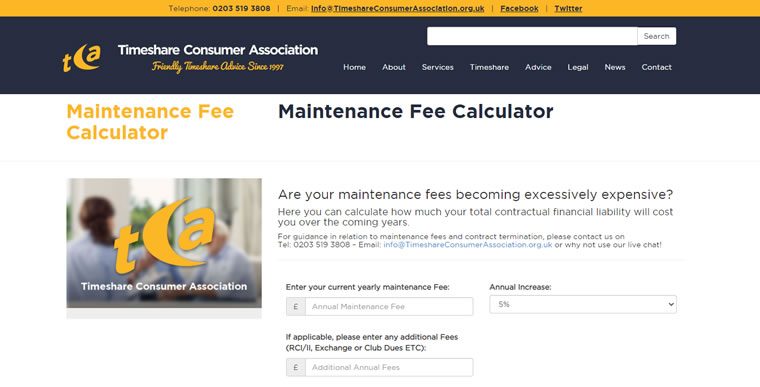
Your annual timeshare maintenance charges may be different from our example, so we’ve created a Maintenance Fee Calculator to help you estimate the figures based on your own circumstances. It shows what you could be expected to pay each year over a 20-year period, as well as the cumulative total. We hope the results don’t shock you too much. You can access the calculator here: https://timeshareconsumerassociation.org.uk/maintenance-fee-calculator/
Once you’ve worked out the potential scale of your future liability — and recovered from the shock — it may be worth reviewing whether timeshare ownership offers genuine value. Remember, maintenance charges typically relate to the provision of self-catering accommodation only: no flights, no transfers, no food, and no spending money.
It’s starting to look like a very expensive proposition.
Let’s look at the pros and cons of owning a timeshare.
Cons:
- Maintenance fees that keep increasing
- Limited exchange power
- No exclusivity – most resorts can often be booked without owning a timeshare
- No realistic resale opportunity
- Costly to relinquish ownership
- Ongoing pressure to upgrade or buy additional encumbrance
Pros:
- A timeshare holiday can work out cheaper if your travel party matches the unit size (for example, 6 people in a 2-bedroom unit) and you’re happy with self-catering. You would need to own at a resort with reasonable maintenance fees, be happy to return each year, and be lucky enough to avoid availability issues when booking. However, this only applies to a very small percentage of owners!
- Holiday memories!
Given the current global situation and the uncertain future of the travel industry as a whole, we do expect many timeshare companies to increase maintenance charges considerably in the coming years to recoup losses — often relying on the force majeure clause in their contracts to absolve themselves of blame in circumstances such as a worldwide pandemic or government-enforced closures. Convenient, perhaps, but as always it’s the timeshare owner who bears the consequences.
In recent months, the TCA has seen increased demand from enquirers seeking assistance with terminating their timeshares and, where applicable, pursuing financial recompense.
If you’d like help and guidance in escaping the timeshare trap and, where applicable, seeking compensation, please feel free to contact us. Our team will be more than happy to assist you.
For friendly advice - call today on 0203 807 3388 or 0800 1026070, or email pr@timeshareadvicecentre.co.uk